There is a useful rule in real estate analysis: pay less attention to what a developer says about a project, and more attention to what they choose to spend design effort on. By that measure, Emaar’s latest reveal for Dubai Square deserves closer scrutiny than its subject matter — parking — might initially suggest.
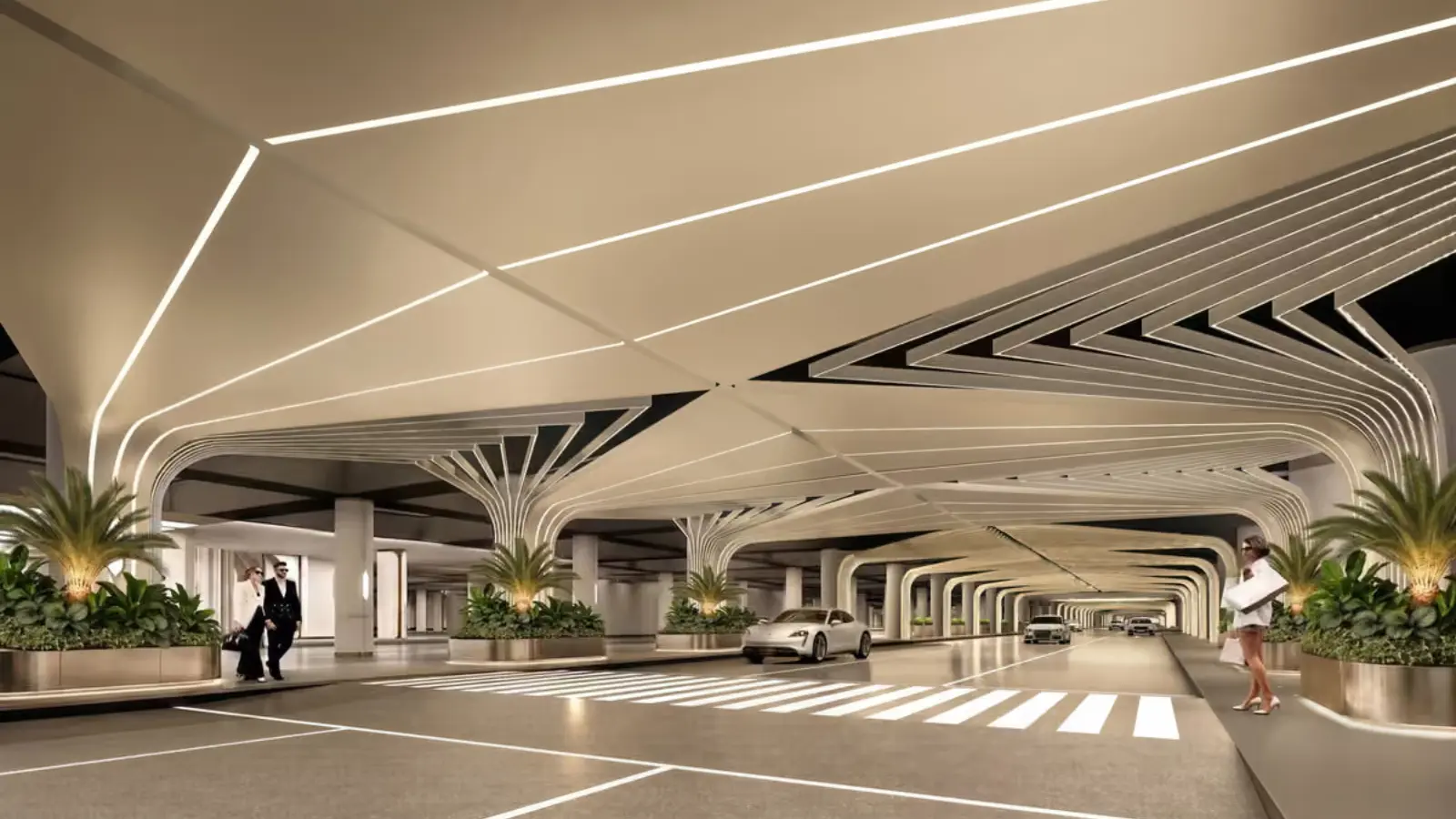
The developer has unveiled plans for a fully climate-controlled, interior-designed parking environment at Dubai Square, the retail centrepiece of its AED 180 billion Dubai Creek Harbour development. On its face, this is a minor operational announcement. Examined more carefully, it is a data point about how Emaar is positioning one of its largest ongoing developments — and what that positioning could mean for the long-term value trajectory of the surrounding real estate.
Reading the Signal, Not Just the Announcement
Parking is typically the last place a developer invests discretionary design budget. It is functional infrastructure, rarely photographed, rarely marketed. Emaar’s decision to apply the same climate control, lighting, wayfinding and architectural detailing used inside the mall to the car park itself is, in that context, a deliberate statement about scope.
“Parking should be comfortable, intuitive and beautifully designed – not an afterthought,” said Emaar Chairman Mohamed Alabbar in the announcement. “Every part of the journey, from arrival to departure, should reflect the quality of the destination.”
Statements like this are common in developer marketing. What distinguishes this one is the scale of the asset it is attached to — and the pattern it fits into.
The Broader Pattern: Dubai Creek Harbour as a Design-Led Bet
Dubai Square was announced in December 2025 as the world’s first drive-through mall, a retail format with no direct precedent in the region. It spans 2.6 million square metres within the wider AED 180 billion Dubai Creek Harbour masterplan — one of Emaar’s largest single developments to date.
Taken individually, the parking announcement is a footnote. Taken alongside the drive-through mall concept, the integrated mobility framework, and the pedestrian-first street design already built into Dubai Creek Harbour’s masterplan, it reads as evidence of a development being engineered end-to-end for experience quality — not simply assembled and sold in phases, as is common practice in the sector.
Why This Matters to Investors
For buyers and investors evaluating off-plan or early-stage opportunities in large masterplanned communities, execution risk is typically the central concern: will the finished product match the initial vision, and will demand hold once the marketing cycle ends?
Design-level details — the kind that don’t make headlines on their own, like parking, wayfinding, or climate systems — are often a more reliable indicator of a developer’s actual execution standards than sales brochures or price-per-square-foot comparisons. Emaar’s willingness to extend design investment into these lower-visibility areas suggests a level of commitment to the finished product that historically correlates with stronger resale performance and tenant demand in comparable large-scale developments.
It is also worth noting Emaar’s track record as context, not proof: the developer behind Burj Khalifa, Dubai Mall and Dubai Fountain has a two-decade history of delivering trophy assets at scale, which lends weight — though not certainty — to its execution claims on Dubai Creek Harbour.
The Investment Case, Stated Plainly
None of this guarantees returns — no single design announcement does. But for investors trying to distinguish between developments built for a quick sales cycle and those built for long-term value retention, the depth of detail a developer is willing to engineer, down to how a visitor experiences a car park, is a legitimate and underused signal. Dubai Creek Harbour, on current evidence, is being built with that level of intent.
Considering Dubai Creek Harbour?
Casa Bella Brokers can walk you through current availability, pricing benchmarks and comparable performance data across Dubai Creek Harbour, so you can evaluate the opportunity on the fundamentals — not just the announcement.
Source :- www.emaar.com, Gulf News